How an E-Bike Can Lose Speed and Range, and what to do about it
Jul 25th 2026
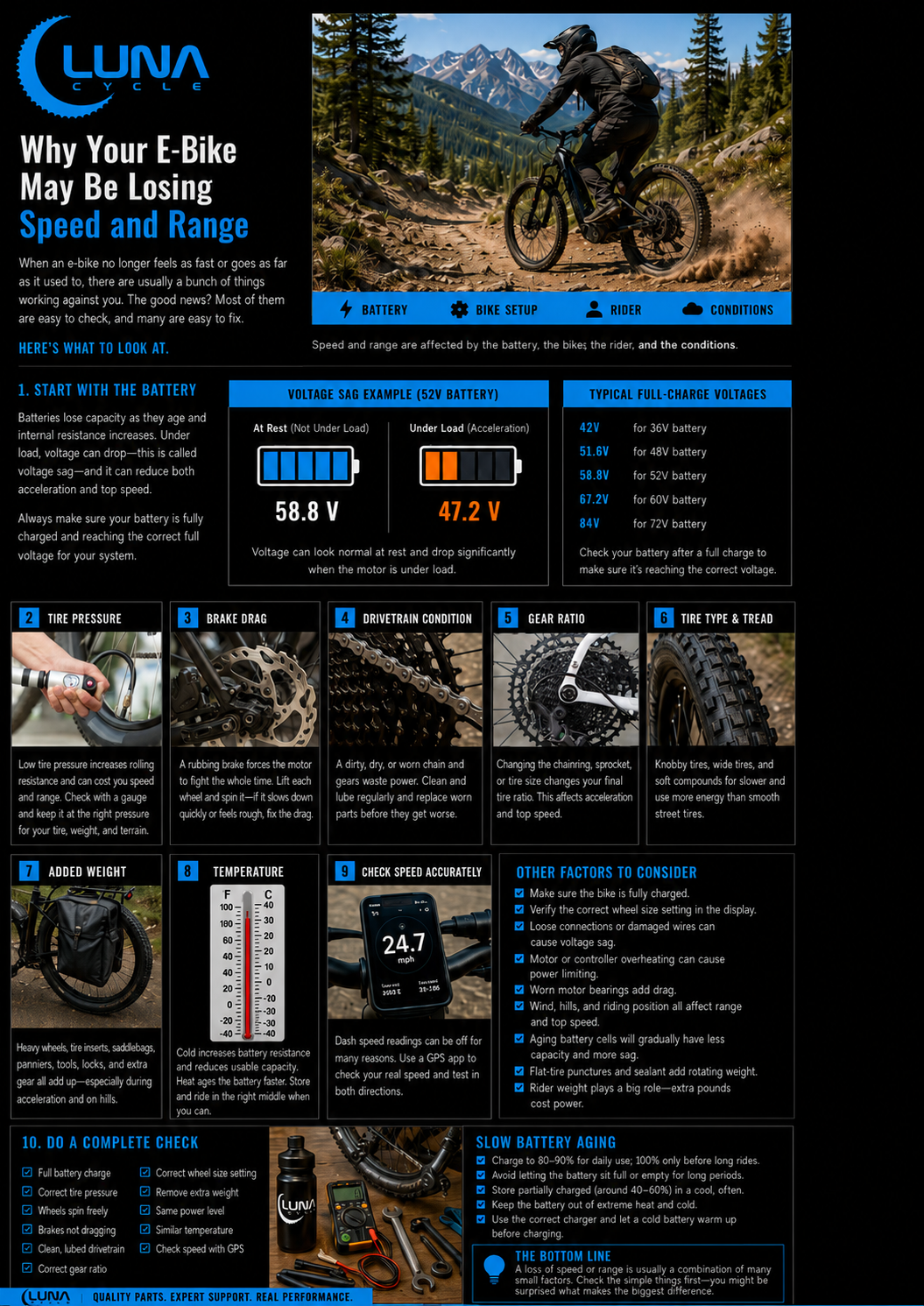
When an e-bike no longer feels as fast or goes as far as it used to, the battery is usually the first thing people blame. Sometimes the battery really is getting tired, but there are plenty of other things that can make a bike feel slower or reduce its range.
Low tire pressure, cold weather, heavier wheels, brake drag, gearing, rider weight, and even tire sealant can all affect performance. In many cases, several small changes are happening at the same time.
Before assuming the battery or motor is failing, it is worth checking the entire bike.
Start with the battery
Lithium-ion batteries gradually lose capacity as they age. Every time the battery is charged and discharged, a small amount of wear occurs inside the cells.
After enough use, a battery that originally held 20 amp-hours may only hold 17 or 18 amp-hours. Since the pack can no longer store as much energy, the bike will not travel as far on a charge.
Battery age can also affect speed through a process called voltage sag.
A battery may show a normal voltage while the bike is sitting still, but that voltage can drop sharply when the motor pulls a large amount of current. This is especially noticeable during hard acceleration, steep climbs, or full-throttle riding.
For example, a pack may read 50 volts at rest and drop to 44 volts under load. The controller and motor operate from the voltage that is available while riding, not the higher resting voltage. More sag can mean weaker acceleration, a lower top speed, or an early low-voltage cutoff.
Some voltage sag is normal. Excessive sag can point to an aging battery, an unbalanced pack, a weak cell group, cold battery temperatures, or a battery that was not fully charged.
Make Sure the Battery Is Actually Fully Charged
Before comparing range or speed, confirm that the battery has completed a full charge.
A charger that stops early, a loose charge connection, an incorrect charger setting, or a battery-management-system issue can leave the pack below its normal full voltage. A battery gauge showing full does not always mean the pack reached its proper charging voltage.
Check the voltage after charging and compare it with the expected full voltage for that battery. Common full-charge voltages include:
- 42 volts for a 36-volt battery
- 54.6 volts for a 48-volt battery
- 58.8 volts for a 52-volt battery
- 67.2 volts for a 60-volt battery
- 84 volts for a 72-volt battery
Voltage should be checked with the correct charger and battery specifications in mind.
Tire Pressure Makes a Major Difference
Low tire pressure increases rolling resistance. The motor then has to use more power just to keep the bike moving.
This can reduce acceleration, top speed, and range. The effect is even more noticeable with wide tires, soft compounds, and heavy e-motos.
Check tire pressure with a reliable gauge instead of squeezing the tire by hand. Use a pressure that is appropriate for the tire, rider weight, terrain, and riding style. The maximum pressure printed on the sidewall is not necessarily the best riding pressure, but riding far below the appropriate pressure will waste energy.
A slow leak can also create a gradual performance loss that is easy to mistake for battery aging.
Tires
Two tires of the same size can have very different rolling resistance.
A smooth street tire will usually roll more easily on pavement than a large knobby tire. Aggressive off-road tread blocks flex as the tire rolls, which consumes energy and can reduce range.
Other tire characteristics also matter, including:
- Tire width
- Rubber compound
- Tire weight
- Sidewall stiffness
- Knob height and spacing
- Tube thickness
- Tubeless inserts
- Puncture-resistant liners
Changing from lightweight street tires to heavy-duty knobbies can make the bike feel slower even if nothing else has changed.
Tire Sealant and Flat Protection Add Weight
Flat-prevention products can also affect performance.
Sealant added to an inner tube or tire increases rotating weight. Heavy-duty tubes, tire liners, foam inserts, and large amounts of flat-fix liquid can add even more.
A few ounces may not sound important, but weight located at the wheel has to be accelerated every time the bike speeds up. It is usually more noticeable during acceleration than while cruising at a steady speed.
Sealant can also collect unevenly or dry into clumps over time, creating additional weight and possible wheel imbalance.
This does not mean flat protection is a bad idea. It simply means that stronger puncture protection often comes with a small performance tradeoff.
Check Whether the Brakes Are Dragging
Brake drag is one of the most common causes of lost speed and range.
A slightly misaligned caliper, bent rotor, sticking piston, tight cable, or incorrectly adjusted lever can keep the brake pads in contact with the rotor. The motor then fights the brakes during the entire ride.
Lift each wheel off the ground and spin it by hand. A small amount of pad noise may be normal with disc brakes, but the wheel should continue spinning freely. If it stops quickly or feels noticeably resistant, inspect the brake adjustment.
Drum brakes and hydraulic systems can also drag, so do not assume the brakes are fine just because the rotor looks straight.
Check the Drivetrain
A dry, rusty, dirty, or worn drivetrain can waste a surprising amount of energy.
On a mid-drive bike, chain condition is especially important because all motor power passes through the chain, chainring, and rear sprocket. A badly worn chain can also damage the gears and reduce shifting quality.
Check for:
- A dry or rusty chain
- Stiff chain links
- Excessive chain tension
- A dirty chain or sprocket
- Worn teeth
- Misalignment
- Damaged wheel bearings
- Incorrect belt tension on belt-drive systems
The rear wheel should rotate smoothly without grinding, binding, or excessive resistance.
Make Sure the Gear Ratio Has Not Changed
Gear ratio directly affects acceleration, motor RPM, and potential top speed.
Installing a larger rear sprocket generally improves low-speed torque and climbing ability, but reduces top speed. Installing a smaller rear sprocket can increase theoretical top speed, but may reduce acceleration and place more load on the motor.
Changes in tire diameter also affect the final drive ratio. A taller tire travels farther with each wheel rotation, while a smaller tire travels less distance.
If the bike feels different after replacing the chainring, sprocket, wheel, or tire, compare the current setup with the original gearing.
On some bikes (particularly Talaria), the display may have settings for gear ratio or wheel diameter. An incorrect wheel-size setting or incorrect gear ratio can make the speedometer and odometer inaccurate.
Do Not Rely Only on the Dash Speedometer
The speed shown on the bike’s display may not be exact.
The readout can be affected by:
- Incorrect wheel-diameter settings
- Changing tire sizes
- Changing wheels
- Sensor or magnet placement
- Controller programming
- Display calibration
- Speed-limiting settings
- Tire growth or compression at speed
When checking whether a bike has actually lost speed, compare the dash reading with a GPS speedometer app on a phone. Test on the same section of road and, ideally, make passes in both directions to reduce the effect of wind and slope.
Phone GPS is not perfect either, but it provides a useful independent comparison. A dedicated GPS unit can provide an even more stable reading.
Aftermarket Wheels Can Add Weight
Aftermarket wheels are not always lighter than the original equipment.
Heavy rims, oversized spokes, stronger hubs, larger brake rotors, thick tubes, rim locks, tire inserts, and heavier tires can add several pounds of rotating mass.
This can reduce acceleration and make the bike feel less responsive. It can also reduce range in stop-and-go riding, where the motor repeatedly has to accelerate the additional weight.
A stronger wheel may still be worth the tradeoff for off-road riding, heavier riders, or improved durability. Just keep the added weight in mind when comparing performance with the original setup.
Rider and Cargo Weight Affect Performance
The motor has to move the total weight of the bike, rider, accessories, and cargo.
Additional weight has a relatively small effect while cruising on flat ground at a steady speed. It has a much larger effect during acceleration and hill climbing.
Weight can come from more than the rider. Common additions include:
- Large locks
- Tool kits
- Spare batteries
- Panniers
- Racks
- Passenger equipment
- Groceries
- Upgraded wheels and tires
- Heavy suspension components
Reducing unnecessary cargo can improve acceleration and range. Rider weight also affects performance, particularly on hilly routes. It is simply another part of the total load the motor must move.
Cold Weather Reduces Battery Performance
Cold temperatures increase the battery’s internal resistance and slow the chemical reactions inside the cells.
A cold battery may have:
- More voltage sag
- Weaker acceleration
- Less usable capacity
- Earlier low-voltage cutoff
- Reduced regenerative-braking performance
The bike may feel noticeably slower on a cold morning even though the battery is healthy. Much of this performance returns when the battery warms back up.
Whenever practical, store and charge the battery indoors at a moderate temperature, then install it shortly before riding. Do not charge a battery that is below the manufacturer’s permitted charging temperature.
High temperatures create a different problem. Heat may temporarily improve power delivery, but prolonged heat accelerates permanent battery aging. Leaving a fully charged battery in a hot garage, shed, vehicle, or direct sunlight can shorten its useful life.
Wind, Hills, and Riding Position Matter
Aerodynamic drag becomes increasingly important as speed rises. A small increase in speed can require a much larger increase in power.
Headwinds, upright riding positions, loose clothing, large panniers, and wide handlebars can all reduce top speed and range. A route that feels flat may also contain enough gradual elevation change to affect the results.
When comparing performance, use the same route, tire pressure, rider position, and weather conditions whenever possible.
The Motor and Controller Can Also Lose Performance
The battery is usually the main age-related factor, but motors and controllers can develop problems too.
Possible causes include:
- Worn motor bearings
- Water or dirt contamination
- Loose phase-wire connections
- Damaged connectors
- Overheating
- Controller thermal limiting
- Motor thermal limiting
- Hall-sensor problems
- Weak electrical connections
- Excessive resistance in battery or motor wiring
A motor or controller that is overheating may provide full power at first and then reduce output later in the ride.
Bearing drag can also build gradually, especially on bikes ridden through water, mud, sand, or road salt.
How to Test an E-Bike Properly
A controlled test makes it easier to separate an actual problem from normal changes in conditions.
Before testing:
- Fully charge the battery.
- Confirm the battery reaches the correct full-charge voltage.
- Set the tires to the same measured pressure.
- Check that both wheels spin freely.
- Inspect the brakes for drag.
- Clean and lubricate the drivetrain.
- Remove unnecessary cargo.
- Confirm the wheel-size and speed settings.
- Use the same riding mode and power setting.
- Check speed with a GPS app instead of relying only on the dash.
Use the same route and try to test at a similar outside temperature. For top-speed testing, make a run in each direction and average the results. For range testing, record watt-hours used when that information is available, not just the number of bars remaining on the display.
How to Slow Battery Aging
Battery wear cannot be eliminated, but it can be reduced.
For everyday use:
- Avoid leaving the battery fully charged for long periods.
- Charge to 80 or 90 percent when full range is not needed.
- Charge to 100 percent shortly before a longer ride.
- Avoid repeatedly running the battery completely empty.
- Store the battery partially charged when it will not be used for an extended period.
- Keep the battery away from excessive heat.
- Allow a cold battery to warm before charging.
- Use the correct charger.
- Avoid charging immediately after a very hot ride.
An occasional full charge may be needed for cell balancing, depending on the battery-management system and manufacturer instructions.
The Bottom Line
A gradual loss of speed or range does not automatically mean the motor or battery has failed.
Start with the simple checks. Confirm the battery is fully charged, measure the tire pressure, look for brake drag, inspect the drivetrain, check the gearing, and compare the speedometer with a GPS app.
Also consider anything that has changed since the bike was new. Different tires, heavier wheels, flat-prevention products, added cargo, rider weight, cold weather, and incorrect display settings can all influence the result.
The battery may still be aging, particularly if there is increased voltage sag or reduced usable capacity. The best diagnosis comes from testing the bike under consistent conditions and looking at the entire system instead of blaming a single component.